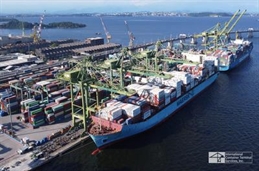
International Container Terminal Services, Inc. (ICTSI) is investing R$948 million (US$163 million) to expand and modernize the operations of the ICTSI Rio Brasil Terminal at the Port of Rio de Janeiro.
The project, which will be executed between 2025 and 2029, will increase the public terminal's operational capacity by 70.5%, from the current 440 thousand TEUs per year to 750 thousand TEUs per year, consolidating Rio de Janeiro as a reference logistics hub for the Southeast and Midwest regions of Brazil.
The total investment of R$948 million comprises approximately R$414.4 million in infrastructure works and R$533.5 million in the acquisition of state-of-the-art equipment.
The actions include the unification and expansion of storage yards, rearrangement of buildings to optimize internal flows, acquisition of new equipment for container handling, modernization of utility systems and electrical infrastructure, as well as investments in technology and automation, with increased efficiency of customer services.
"It's an investment of almost R$1 billion that will be essential for us to expand operations here at the port, going from 440 thousand to 750 thousand TEU and, in the future, perhaps reaching 1.2 million," said Brazil Minister of Ports and Airports, Silvio Costa Filho.
Filho noted that the investment policy is part of a strategy to increase the competitiveness of the national port system.
"As of November 30, the Port of Rio had already grown 14% in cargo movement. This is important because, when we put the port in partnership with the Federal Government, the state government and municipalities, we strengthen the country's production chain and logistics."
The project includes the implementation of advanced access control, monitoring and cargo management systems, as well as the adequacy of the infrastructure to meet recent regulatory requirements, especially the rules of the Brazilian Federal Revenue Service.
It also promotes environmental sustainability measures, in line with ICTSI's global commitments to sustainability.
"This is a transformative project that reinforces our commitment to Brazil and expansion, efficiency and competitiveness of the national logistics chain. This effort is in addition to our investments in the Rio-Minas and Rio-Suzano logistics corridors, where ICTSI has already invested more than R$190 million, with an emphasis on rail transport. Thus, we will not only expand the capacity of the Rio Brasil Terminal but also be able to help mitigate the congestion observed in the Port of Santos, better distributing the port demand in the country" said Roberto Lopes, Rio Brasil Terminal chief executive officer.
The expansion of the Rio Brasil Terminal will allow the terminal to continuously operate large vessels on the full berth, including new Panamax and post-Panamax vessels, up to 366 meters long (LOA) and with a capacity of more than 13,000 TEUs.
This adaptation is essential to keep up with the global trend of increasing the size of vessels that call the east coast of South America. The first two new cranes already arriving mid-2026 are built for the world's largest vessels with a length of 400 meters.
In addition, the Port of Rio de Janeiro has registered a significant and continuous increase in container handling, a direct reflection of the growth of Brazilian foreign trade.
Since 2023, there has been a significant increase in volume handled, a trend that continues in 2025 and is expected to continue in the coming years.
With new cranes and additional yard capacity already being available in 2026, ICTSI Rio is already in the market now offering this additional capacity to customers. With the full implementation of the investments, the terminal will be operating with capacity utilization of around 75% between 2029 and 2030, ensuring more predictability and competitiveness for the port of Rio de Janeiro.
This translates into more fluid operations, limited waiting times, reduced logistics costs, and greater resilience in the face of possible bottlenecks in other ports. Without the interventions, the terminal could be saturated between 2027 and 2028, according to projections.