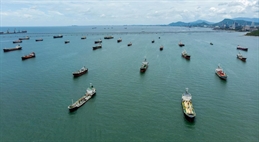
Ocean carriers are preparing to impose a broad range of emergency surcharges as Iran's attacks on vessels in and around the Strait of Hormuz continues.
Judah Levine, head of research at Freightos, said the industry is entering a period of significant rate pressure as carriers roll out new fees as the tension in the Middle East disrupt fuel access and push up operating costs across global trade lanes.
The Freightos analysis noted that the strikes, once limited to ships transiting the Strait of Hormuz, have expanded to vessels in the Persian Gulf, Gulf of Oman, and even some other regional ports, prompting ocean carriers to reroute and absorb higher costs.
"Carriers have announced flat-rate global emergency fuel surcharges of several hundred dollars per FEU that will go into effect early next week," Levine said.
"For the container market, operational disruptions continue to be limited to Gulf-bound or originating cargo, with some knock-on congestion elsewhere. As in previous disruptions like the Red Sea closure, carriers are now adjusting to the new reality and freight is finding its way," he added.
After initially suspending bookings to the Persian Gulf, carriers like CMA CGM and Maersk are now accepting new bookings by diverting volumes to alternative accessible ports in the region – including ports in Oman, UAE, and Saudi Arabia – with containers moving on by landbridge.
Carriers are also relying heavily on ports in India with new shuttle services ferrying containers to those accessible Mideast ports – though even some of these, like UAE's Fujairah are now being directly targeted by Iran.
Nonetheless, Freightos noted that congestion is already building at these alternative hubs, with Colombo reportedly declining additional Gulf‑bound volumes due to existing backlogs.
For the rest of the container market, while operations are unaffected by the war, container rates are not likely to be spared.
Fuel surcharges planned
With the planned flat-rate global emergency fuel surcharges, Ocean expert Lars Jensen noted that prolonged fuel fees like these would push rates up, but they would not represent unprecedented fuel pass throughs, and would be "expensive, but not destructive" to the market, possibly pushing rates back up to 2024 levels.
"But while initially it seemed non-Gulf lanes would only be impacted by fuel surcharges, by mid-last week carriers announced a flurry of significant emergency surcharges, PSSs and GRIs across a range of lanes, including Asia - Europe and the transatlantic, some representing thousands of dollars in increases per container," Freightos said in its analysis.
These hikes are raising concerns among shippers in ongoing annual contract negotiations.
Spot rates, meanwhile, have so far remained relatively steady ahead of the surcharges. Transpacific prices hovered around US$2,000/FEU to the West Coast and US$3,000/FEU to the East Coast, while Asia–Europe rates climbed to US$2,900/FEU to North Europe and US$4,300/FEU to the Mediterranean.
In air cargo, capacity shortages from attacks on Gulf airports have pushed rates sharply higher on Asia–Europe lanes, though some prices have begun to stabilize as carriers restore partial operations.
Freightos said Iran also persists in its attacks on regional airports which serve as hubs for major cargo players like Emirates Skycargo and Qatar Airways Cargo, and crucial global connection point, especially for Asia - Europe lanes.
"While Qatari airspace remains closed, and Qatar Airways’ Mideast operations along with it, the UAE has gradually restored flight schedules after being closed completely during the first few days of the war and despite ongoing drone and missile attacks. Just this past week the airport in Dubai faced multiple attacks, some of which closed the airport for several hours," the analysis said, adding that with the drop in available capacity out of these Gulf hubs and the increase in Asia volumes looking for alternate routes to Europe.
These is causing rates to spike on many of these lanes. South Asia - Europe prices climbed to 84% higher than just before the war began, with South East Asia - Europe rates up 26% and Europe - Middle East prices up 57%, with some of these increases likely partially due to fuel surcharges being rolled out by some carriers.
But with Qatar Airways still largely grounded for services in and out of Doha, about 5% of global capacity is still absent from the market and is likely still an important factor to capacity and rate levels.