Air cargo spot rates are continuing to rise sharply amid the highly volatile, unstable, and fast-changing situation in the Middle East, following the military attacks on Iran by the U.S. and Israel, and Iran's retaliatory strikes on targets in the region.
The latest weekly figures from WorldACD Market Data highlight that there has been some recovery in air cargo markets since the outbreak of the war, although the situation for carriers, airports, and other stakeholders in the region remains extremely challenging and subject to sudden and rapid change.
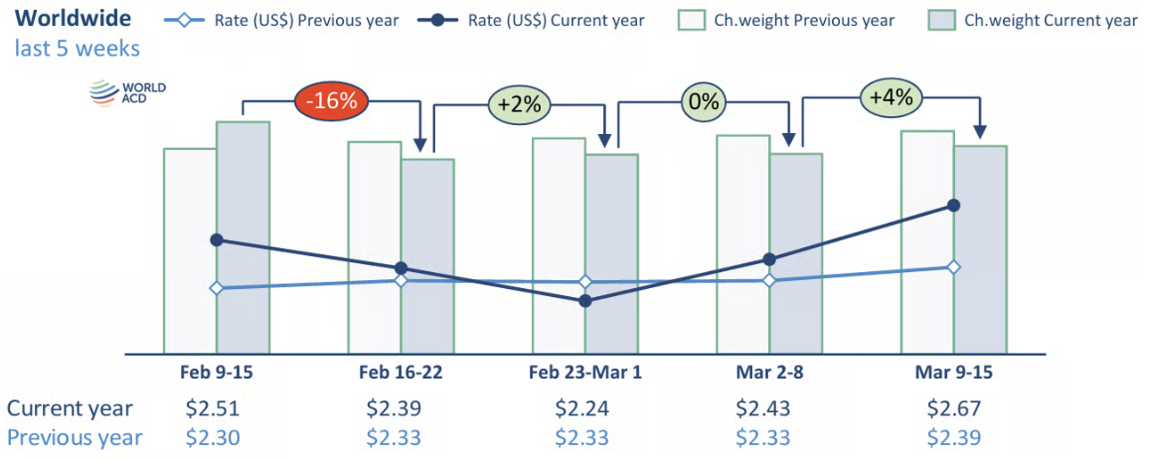
According to the more than 500,000 weekly transactions covered by WorldACD's data, average global full-market air cargo rates rose by a significant 10%, week on week (WoW), in week 11 (March 9 to 15) to US$2.67 per kilo (including surcharges) after surging 8% the previous week, as carriers, freight forwarders, and cargo owners responded to disrupted markets, constrained air cargo capacity, alternative flight routings, demand backlogs, uncertainty, and higher jet fuel prices.
(Source: WorldACD)
Worldwide volumes recorded a 4% WoW increase, due to a further post-Lunar New Year recovery and partially returning volumes from Middle East & South Asia (MESA) origins, although global tonnages were 7% down, year on year (YoY), and the situation in the Middle East remains highly fluid.
Middle East & South Asia spot rates surge
Average worldwide spot rates rose by 12%, WoW, to US$3.19 per kilo, taking them 22% higher than in the equivalent week last year.
WorldACD said understandably, the biggest spikes in spot rates occurred from MESA origins, where spot rates spiked by a further 22%, WoW, to US$4.37 per kilo, up 58% compared with last year.
"Although air cargo capacity and traffic recovered significantly compared with the previous week, thanks to the partial reopening of some airports and airspace in the region and alternative routings avoiding restricted areas, air cargo capacity and services to and from the region remain highly constrained, particularly within Gulf countries, and subject to sudden disruptions, delays and backlogs," the air cargo market data provider added.
WorldACD added that the 30% WoW rebound in volumes from MESA origins followed their 33% decline the previous week as capacity from the region collapsed in week 10, or down 50%, WoW.
Capacity in the region picked up last week, rising 35% from the week before. As a result, cargo volumes from Gulf countries rebounded sharply—up 74% after having dropped 65% the previous week. Even with this jump, tonnages are still about 50% below where they were before the conflict began in mid‑February.
Tonnages from South Asia origins – normally heavily dependent on capacity from Gulf carriers – also partially rebounded with a 24% WoW rise, although they are still 20% below their pre-war levels.
MESA to Europe and U.S. volumes rebound partially
Traffic from the Middle East–South Asia region is recovering, but still below pre‑war levels. WorldACD said volumes from MESA to Europe rose 27% week‑on‑week, though they remain 20% below pre‑war and 9% lower than a year ago.
Dubai tonnages jumped 67% after last week's drop, but are still 30% under their pre‑war baseline. Spot rates from MESA to Europe continued climbing, up 21% after a 60% surge the week before, now 70% higher than last year and nearly double pre‑war levels. Dubai rates rose another 9% after a 90% spike, reaching US$3.93 per kilo—more than twice last year and pre‑war.
A similar trend is visible on MESA–U.S. lanes. Volumes increased 22% week‑on‑week but remain 20% below pre‑war, though only 2% under last year. Spot rates from MESA origins to the U.S. rose 25% after a 30% jump the previous week, now 50% above last year and more than 65% above pre‑war.
Dubai–US rates surged 56% to US$8.46 per kilo after nearly a 50% rise the week before, putting them at 2.5 times last year's level and above pre‑war.
Highly volatile environment and jet fuel issues
"However, underlying the highly volatile environment, since the end of last week there have been further new restrictions on capacity to and from the United Arab Emirates, where only UAE-based carriers are currently permitted to operate flights, after a drone strike on a fuel terminal severely limited jet fuel availability," WorldACD said.
Meanwhile, the world's biggest international air cargo carrier, Qatar Airways Cargo, on March 19 announced plans to resume selected freighter operations to and from Doha, where services had been suspended for the previous three weeks, while they continued to operate some limited freighter services outside Doha.
Jet fuel availability and prices have also become a major factor in recent weeks, with an effective blockade of the Strait of Hormuz leading to a further 11% WoW rise in jet fuel prices, to almost double (up 94%) their pre-war level.
WorldACD said this has triggered carriers to implement additional air cargo fuel surcharges, with some also implementing war-risk surcharges, contributing to the rising levels of overall air cargo rates.