Asia Pacific airlines posted solid cargo growth in February despite factory closures during the festive period, but the outlook has turned more uncertain as escalating Middle East tensions, airspace restrictions, and surging fuel prices weigh on operations.
Traffic figures released by the Kuala Lumpur-based Association of Asia Pacific Airlines (AAPA) showed "strong growth" in February as the region's carriers saw trade activity remained resilient, reflecting demand for consumer, intermediate and investment goods.
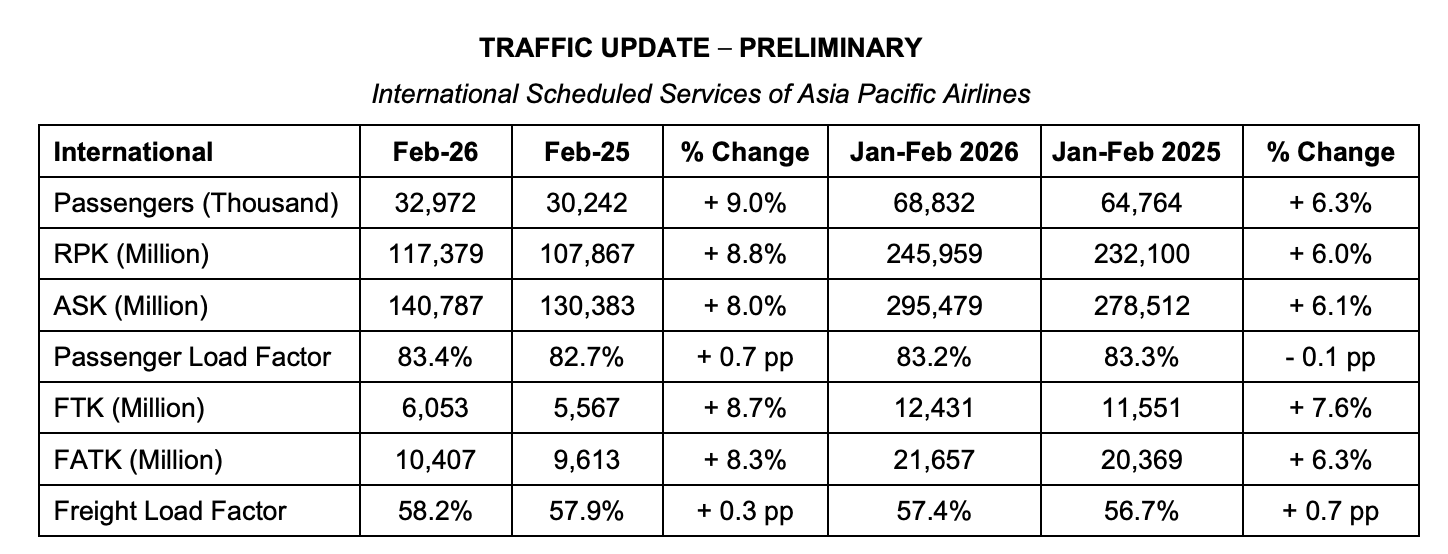
International air cargo demand — measured in freight tonne-kilometers (FTK) — was up 8.7% year-on-year in February to 6.053 million tonnes from the 5.567 million tonnes during the same month in 2025.
February's cargo performance was, however, slightly lower than the 6.34 million tonnes recorded at the start of the year in January. At the close of 2025 in December, international air cargo demand stood at 6.9 million tonnes.
AAPA said for February, demand growth outpaced a corresponding 8.3% increase in offered freight capacity, resulting in a 0.3 percentage point rise in the average international freight load factor to 58.2%.
Subhas Menon, AAPA Director General, said "positive business confidence, alongside rising orders for goods manufactured in Asia, supported growth in international air cargo demand, with volumes rising by a solid 7.6% during the first two months of 2026, compared to the same period last year."
(Source: AAPA)
Meanwhile, Menon warned that rising instability in the Middle East is adding fresh uncertainty for Asian carriers.
"The escalation in geopolitical tensions in the Middle East region at the end of February has introduced greater uncertainty to the operating environment," he said. "Asian airlines are facing increased operational challenges, as the rise in conflicts has reduced the availability of airspace, particularly along key Asia - Europe corridors, effectively constraining capacity on these routes and limiting network flexibility for affected carriers."
He pointed out that soaring jet fuel prices have added another layer of pressure for carriers.
"The sharp increase in jet fuel prices from an average of US$90 per barrel in the first two months of the year to an average of US$150 per barrel in the first three weeks of March, has left little time for airlines to adjust, while longer flight routings have increased operating costs, placing additional pressure on already thin profit margins," the AAPA chief executive said.
Looking ahead, Menon said while the outlook is broadly positive, evolving geopolitical tensions continue to cast uncertainty over the months ahead.
"The broadly positive outlook for the airline industry will continue to be clouded by the evolving geopolitical situation. Prolonged conflicts over the Middle East may increase inflationary pressures and affect business and consumer sentiment on both passenger and cargo markets," he said.
"Close coordination between governments and industry stakeholders is critical to ensure the continued safe and efficient operation of air services, while maintaining global connectivity," the AAPA chief added.