
Global container shipping lines closed 2025 with a combined operating profit of USD 15.4 billion, according to Sea‑Intelligence's latest Sunday Spotlight, marking a substantial decline from the US$35.4 billion recorded in 2024 but still a level that keeps the sector above its pre‑pandemic performance range.
The Danish maritime consultancy company said this point to a measured normalization rather than a severe downturn, with all reporting carriers maintaining positive EBIT despite broad year‑on‑year reductions.
"The data indicates that the industry has achieved a soft landing rather than a catastrophic crash, with the reporting carriers recording a combined US$ 15.4 billion EBIT for 2025. While this represents a significant cooling from the US$35.4 billion operating profit seen in 2024 – and remains a fraction of the 2021‑2022 peaks – profitability remains comfortably above pre‑pandemic levels," said Alan Murphy, CEO, Sea-Intelligence.
COSCO generated the highest operating profit in 2025 at US$4.93 billion, followed by Evergreen (US$2.36 billion), OOCL (US$1.54 billion), and Maersk (US$1.39 billion), while ONE and Yang Ming reported the smallest gains at US$459 million and 472 million, respectively.
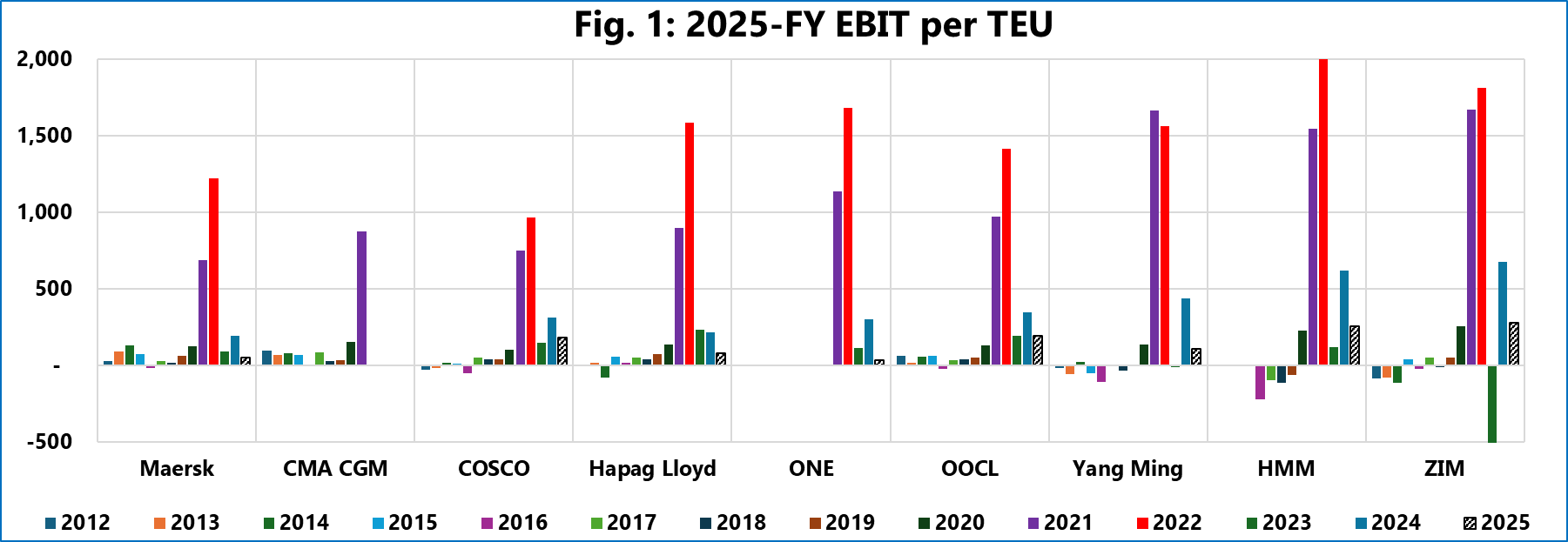
(Source: Sea-Intelligence)
"Focusing solely on the Y/Y decline masks an important historical reality: for most shipping lines, 2025 EBIT/TEU is still stronger than pre‑pandemic levels," Murphy added.
EBIT per TEU fell across every carrier, though several — including ZIM (US$277/TEU), HMM (US$257/TEU), OOCL (US$195/TEU)), COSCO (US$180/TEU), and Yang Ming (US$107/TEU) — still posted stronger per‑unit earnings than in any year from 2010 to 2019.
Meanwhile, Hapag-Lloyd (US$83/TEU) and Maersk (US$54/TEU) are now operating at margins closely mirroring their historical averages from the 2010‑2019 decade.
For others, such as Hapag‑Lloyd and Maersk, 2025 margins aligned closely with long‑term historical averages.
Overall, the 2025 results suggest the industry has stabilized at profitability levels comparable to the early 2010s, remaining well above the weaker margins seen in the late 2010s.