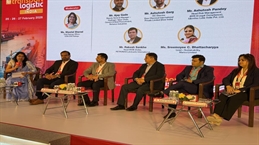
Industry leaders at Transport Logistics India have called for urgent action to decarbonize and future-proof supply chains amid rising environmental pressures and evolving global trade expectations.
During a panel discussion titled, “Green Moves: Driving Sustainability Through Circular Supply Chains,” speakers underscored the sustainability ambition of both the Indian industry and the complexity of transforming long-established logistics systems.
Moderator Sheetal Sharad, chief ratings officer at ICRA ESG Ratings, opened the discussion by stressing that supply chains must evolve rapidly in the climate era, calling sustainability “a strategic reinvention rather than an incremental upgrade,” as she invited panellists to outline challenges and successes tied to green logistics.
Supplier Engagement and Multimodal Efficiency
Shreemoyee C. Bhattacharyya, lead-sustainability at Marico Limited, outlined the company's sustainability roadmap, including its goal to reach net-zero for Indian operations by 2030 powered by 93% renewable energy, while noting that Scope 3 emissions remain a major frontier.
She said Marico is pursuing scalable, partner‑driven decarbonization through route optimization, multimodal freight shifts, and a supplier program designed to “educate, evaluate, and evolve” ESG practices. “We need a simple, pragmatic ESG roadmap that suppliers can actually adopt,” she said.
This focus mirrors broader national logistics priorities, with road freight accounting for 70% of India’s logistics movement and contributing roughly 12% of the country’s total greenhouse gas emissions—a key challenge to meeting long‑term national net‑zero targets.
Policy and Cost Barriers Slow Transformation
Ashutosh Pandey, head of risk management (EHS & legal compliance) at Idemitsu Lube India, outlined the lubricant sector’s difficulty in adopting circular models, noting that used oil recovery remains costly and technologically fragmented.
He then called for stronger government support, standardized recycling frameworks, and IT-enabled traceability to ensure safe and efficient collection. Innovations — from biobased base oils to lowtemperature blending and renewablepowered manufacturing — are already emerging, but scaling them will require more robust policy incentives and deeper industry collaboration.
India’s broader logistics landscape reflects these hurdles: heavy dependence on trucks, a fragmented operator base, and high transition costs continue to slow the uptake of lowcarbon technologies.
Hydrogen as a Strategic Decarbonization Lever
Representing the energy sector, Ajay Gale, deputy general manager – hydrogen supply chain, cement & steel procurement at Reliance Industries, argued that alternative fuels — especially green hydrogen — must play a larger role as India tries to delay its climate “tipping point.”
He acknowledged significant challenges, including infrastructure gaps and high capital costs, but pointed to Reliance Industries’ push toward 10 GW of hydrogen capacity by 2030, supported by investments in solar, battery storage, and electrolysis.
“The tipping point can be delayed only with alternative fuels,” Gale noted, highlighting hydrogen’s potential in long-haul and heavyindustry logistics.
India’s broader decarbonization forecasts echo this urgency: freight trucks produce 38% of roadtransport CO₂ emissions, meaning cleanfuel transitions —hydrogen, LNG, and electrified corridors — will be essential to keeping logistics both economically viable and aligned with climate goals.
Green Warehousing: Efficiency, Certification, and Safe Operations
In the warehousing segment, Rakesh Sankhe, head HSSE (India) at Petronas Lubricants International, described the rising trend of LEED-certified, solarpowered, energy-efficient warehouses.
Green warehousing practices significantly reduce emissions through renewable energy use, stronger waste-management systems, and safer, battery-operated material-handling equipment. Sankhe said that sustainability must be integrated with safety and operational reliability.
This trend is playing out nationwide as Indian companies increasingly pursue “green warehouse” models to reduce energy consumption and build resilience, with sustainability gains from optimized layouts, efficient lighting, and renewable power systems.
Digitization and Network Optimization: Dow’s DataDriven Approach
Ashutosh Garg, ISC director for Dow India, noted that true decarbonization requires end-to-end digital integration, including forecasting tools, global standardization, and supplier partnerships.
He highlighted a “360-degree supplier model” combining training, audits, ESG codes of conduct, and joint disclosure—arguing that long-term transformation hinges on treating suppliers as partners rather than compliance obligations.
Digitization is also reshaping India’s logistics reforms, with platforms such as ULIP recording over 10 billion API transactions by March 2025, enabling real-time cargo visibility and driving major efficiency gains.
National Momentum: Low Emission Trucks, Multimodal Corridors, and Budget 2026 Expectations
Across India’s logistics ecosystem, multiple green initiatives are gaining momentum. A US$275 million national investment is rolling out 10,000 low-emission trucks and building 100 alternative-fuel stations, expected to reduce 1 million tonnes of CO₂ annually.
Meanwhile, multimodal integration — through Dedicated Freight Corridors and a growing network of Logistics Parks — is strengthening the structural backbone needed for cleaner transport and lower logistics costs.
Industry leaders anticipate that Budget 2026 will push harder on execution-focused reforms, particularly integrated planning, sustainable fleet incentives, and technology adoption.
A Collaborative Path Forward
Audience questions on AI, hydrogen transport, and Scope 3 verification underscored that sustainability challenges are systemic rather than sector-specific. Panellists agreed that innovation, regulatory alignment, and supplier partnerships will determine how quickly India can transition toward climate-aligned logistics.
As Sharad concluded, “Sustainability is no longer a compliance tickbox—it’s a reengineering of how supply chains think and operate.” With India simultaneously expanding freight capacity and decarbonizing infrastructure, the coming decade will shape whether its supply chains become global competitiveness assets—or liabilities.
By Darren Barton, Air Cargo India, Mumbai