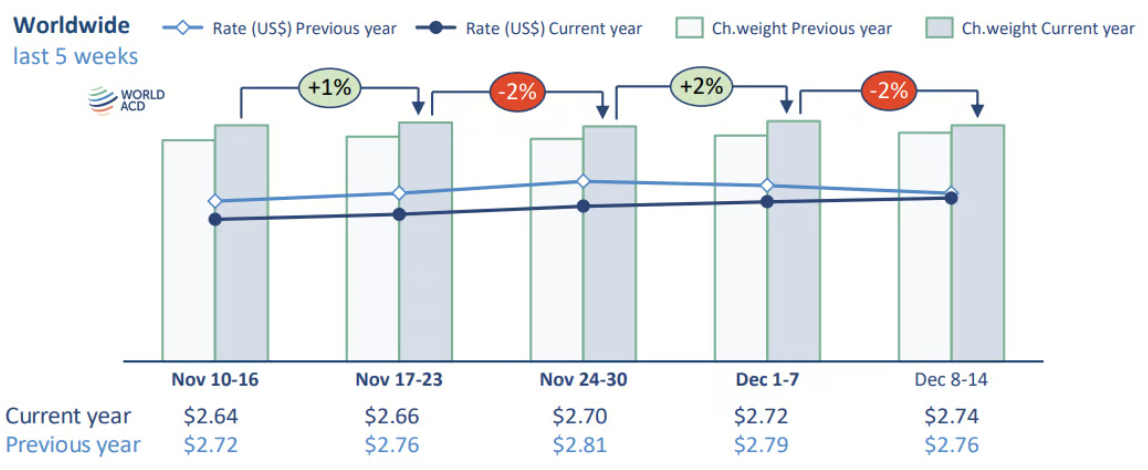
Worldwide air cargo tonnages edged back downwards slightly in the second week of December after peaking in early December at a level around 5% higher than last year, with rates rallying close to last year's elevated peak-season levels.
According to the latest weekly figures and analysis from WorldACD Market Data, total global tonnages dipped by 2% in week 50 (December 8 to 14), while average worldwide rates edged slightly higher (+1%) to US$2.74 per kilo, less than 1% lower than their equivalent rate this time last year.
Steady rate gains in the last three months have gradually closed the gap between prices this year and their relatively high levels in the fourth quarter (Q4) of last year, progressively narrowing the deficit from -5% in September to an estimated 2% in December.
Based on the current trends and trajectory, worldwide air cargo tonnages are set to end the year with a year-on-year (YoY) increase of 5% in December, the same YoY rise recorded in November.
WorldACD said that will take total worldwide full-year tonnages in 2025 to around 4% higher than last year.
Worldwide rates in 2025 will average out broadly similar to their level in full-year 2024 at around US$2.47 per kilo, having recorded YoY gains in the first four months of this year but mostly been below last year's levels in the latter half of the year.
(Source: WorldACD)
"As is typical for this time of year, average worldwide spot rates started edging back downwards in week 50, along with tonnages – indications that air cargo is now 'past the peak,' as end-of-year restocking begins to ease in the final few weeks before the Christmas and New Year holiday periods," WorldACD said.
It added that with spot rates sliding by 1%, week on week (WoW), the overall slight WoW global rate increase in week 50 was driven by small shifts in longer-term contract rates patterns.
Asia Pacific to US spot rates rise further
On the big markets from Asia Pacific to the US and Europe, tonnages dipped, WoW, but spot rates continued rising from many key origin markets.
It said that chargeable weight from Asia Pacific to the US in week 50 dropped by 4%, WoW, driven down mainly by a 8% WoW fall from China origins. But spot rates from parts of the region to the US continued to rise, increasing by 3%, WoW, to US$6.57 per kilo, thanks to surging spot rates from Hong Kong (+12%, WoW), South Korea (+15%) and Singapore (+15%) – taking Asia Pacific to the US average spot rates to within -3% of their level this time last year, their narrowest year-on-year (YoY) deficit in more than six months.
Despite the huge turbulence experienced by the China to US market this year, spot rates in week 50 of US$6.96 per kilo were back up to their level in week 50 last year.
In comparison, WorldACD said Asia Pacific to Europe tonnages dropped by 2%, WoW, largely due to decreases in traffic from China and Hong Kong, and to a lesser extent Vietnam. But YoY, Asia Pacific to Europe tonnages are an extraordinary 11% higher, with big YoY increases from Taiwan (+27%), Hong Kong (+15%), Vietnam (+16%), Indonesia (+12%), and China (+11%).
Those YoY increases in 2025 also follow double-digit percentage growth in 2024.
On the capacity side, total worldwide capacity looks set to end the year around 7% higher, YoY, including double-digit percentage increases from Africa (+18%), Central & South America (+12%) and Europe (+11%) origins, but also significant YoY growth from Middle East & South Asia (+8%) and Asia Pacific (+7%), while North America is growing more moderately (+3%).
The end of a volatile year
"In what has been a highly volatile and turbulent year for air cargo, tonnages have grown by an additional 4% in 2025 on top of the 11% growth the previous year," WorldACD said. "And rates for 2025 as a whole have broadly matched their relatively high levels last year, thanks in part to a steady strengthening of spot prices in the final months."